In the rapidly evolving digital landscape of 2026, the velocity of information often exceeds our biological and systemic ability to comprehend it. The nature of fraud has undergone a fundamental, structural transformation. We are no longer dealing with lone wolves or static email campaigns; we are facing highly agile, algorithmic syndicates that orchestrate dynamic operations pivoting with lightning speed.
By the time a novel phishing technique or a sophisticated investment “pig butchering” scheme makes the evening news, the criminals behind it have usually already extracted their value and moved on to their next target. This fundamental misalignment—the gap between the speed of fraud execution and the speed of public awareness—creates an asymmetric battlefield. On this field, defenders, financial institutions, and everyday consumers are consistently playing a desperate game of catch-up.
This is where the Civoryx Global Fraud Index changes the math.
Civoryx is the definitive barometer for tracking how fraud attention and victimization shift across the internet in real-time. At its core, Civoryx provides the transparency and visibility required to level the playing field. Unlike traditional cybersecurity reports that rely on “post-mortem” analysis—counting the money after it’s already gone—the Civoryx Index leverages the purest signal available in the digital age: aggregate human behavior.
By tracking what billions of people are searching for, Civoryx measures exactly where scams are proliferating long before the ultimate financial toll is officially tabulated by government agencies. This guide serves as the comprehensive manual for understanding, interpreting, and utilizing the Civoryx Index to protect yourself, your enterprise, and your community.
The Philosophy: Why Civoryx Exists
The creation of Civoryx was not sparked by a desire for more data, but by a realization that our current data is dangerously late. To understand why Civoryx is revolutionary, we must first understand the “Latency Problem” that plagues modern fraud defense.
The Latency Problem
When a new scam variant launches—for example, a sophisticated SMS campaign impersonating a national toll authority (the “EZ Pass” scam)—the victim’s first instinct isn’t to call the police. It is to search:
- Is the EZ Pass text message real?
- How do I pay a toll violation online?
- EZ Pass scam text 2026.
This spike in search queries represents the very first measurable indicator that a new scam is scaling. It is the “smoke” before the “fire.”
Traditional fraud reporting, however, works in reverse. A victim loses money, they experience the trauma of the theft, and eventually, they may file a report with the FTC (Federal Trade Commission) or the FBI’s IC3. These agencies then aggregate these reports over months, eventually publishing a bulletin. By the time the public is warned, the scam has already reached its “saturation point,” and the perpetrators have shifted their infrastructure to a new lure.
The Civoryx Thesis: Fraud evolves faster than headlines. To stop fraud, we must track the curiosity and confusion of the potential victim in real-time.
The Data-Driven Solution
Civoryx was engineered to bridge this gap. By tapping into global search patterns, the index provides a real-time lens into the queries that dominate the collective consciousness regarding digital deception. It answers the fundamental question: What is the world searching for right now regarding fraud?
This approach transforms fraud detection from a reactive autopsy into a proactive early warning system. For researchers, journalists, and businesses, having access to this data means the difference between being a victim and being prepared.
Understanding the Mechanics: Monitor, Measure, Score
The Civoryx Global Fraud Index is built on a tripartite mathematical structure designed to ensure that the data is not just “big,” but “meaningful.” It distills millions of data points into a single, digestible metric: the Scam Trend Score.
Monitor: The 150 Keyword Index
The foundation of Civoryx is a meticulously maintained directory of over 150 fraud-related search terms. This is not a static list; it is a living taxonomy that spans the entire spectrum of modern fraud, including:
- Social Engineering: Queries like “phishing link” or “how to spot a scam.”
- P2P & Banking: Searches for “Zelle scams” or “Chase fraud number.”
- Infrastructure & Impersonation: “Toll scam text,” “DMV scam,” or “Geek Squad invoice.”
- Emerging Tech: “Coinbase text scam” or “AI voice scam.”
Measure: Weighted Month-Over-Month Velocity
Raw search volume is often misleading. For example, the word “phishing” will always have high volume. If it increases by 5%, it’s notable but expected. However, if a niche term like “EZ Pass Scams” jumps from 100 searches to 8,000, that is a 7,900% increase—a clear signal of a viral attack.
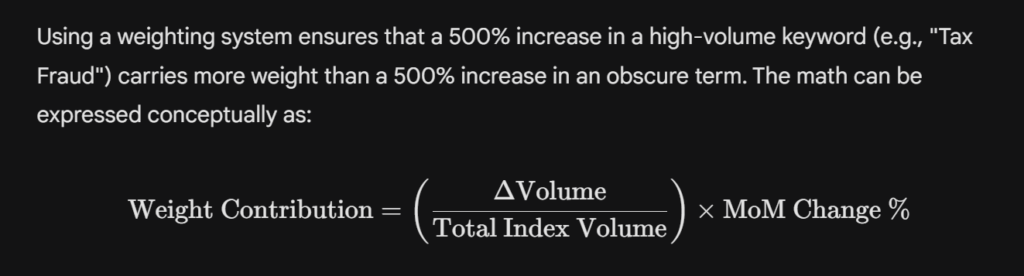
Score: The Scam Trend Score
The final output is the Scam Trend Score. This composite metric acts as the “heartbeat” of global fraud activity.
A rising score indicates that fraud-related search interest is accelerating. New campaigns are launching, and the public is increasingly encountering deception. A falling score suggests that scam activity is cooling off, perhaps due to law enforcement intervention or the natural “decay” of a specific scam’s effectiveness.
The February 2026 Snapshot: A Deep Dive into the Data
To see the power of the index, we must look at the most recent data pull. In February 2026, the aggregate Scam Trend Score reached a staggering 226.68, driven by a perfect storm of seasonal anxiety and infrastructure-based “smishing” (SMS phishing).
The “Smishing” Explosion: The EZ Pass Case Study
The standout anomaly of early 2026 was the “EZ Pass Scam.” As many states transitioned to 100% digital tolling, scammers found a massive opening.
| Keyword | Jan Volume | Feb Volume | % Change |
| EZ Pass Scams | 140 | 8,100 | +5,685.7% |
| Toll Scam Text | 130 | 3,200 | +2,361.5% |
| DMV Scam Text | 230 | 3,200 | +1,291.3% |
This data shows a coordinated, nationwide deployment of fraudulent texts. Because “EZ Pass” is a trusted utility, victims are more likely to click a link to “pay a fine” to avoid a registration suspension. Civoryx flagged this spike weeks before traditional news outlets began running “Consumer Alert” segments.
Seasonal Surges: The Tax Fraud Juggernaut
February is the beginning of the “Tax Fraud” season. The index captured a massive migration of search intent toward IRS impersonation:
- Tax Fraud: Searches jumped from 8,100 to 74,000 (+813.58%).
- Contribution: This single keyword contributed 75.74 points to the overall Scam Trend Score.
This highlights how scammers relentlessly exploit the calendar. They know when people are waiting for W-2s and refunds, and they adjust their scripts accordingly.
Brand Impersonation: The “Big Three”
Scammers rely on the “Halo Effect”—the trust consumers have in major brands. By aggregating searches, Civoryx can rank which companies are being most heavily exploited by fraudsters:
- PayPal: 51,800 searches (Primarily “PayPal scam email” and “PayPal fraud”).
- Chase: 18,100 searches (Primarily “Chase fraud number”).
- Coinbase: 12,100 searches (Primarily “Coinbase text scam”).
The 150 Keywords: The DNA of the Index
The Civoryx Index monitors these 150 terms because they represent the “Pain Points” of the digital consumer. They are categorized to show how scammers target different parts of our digital and emotional lives.
Phishing & Digital Communication
These terms track the most common methods of entry for fraudsters—spoofed emails, malicious links, and “smishing” (SMS phishing):
- phishing
- phishing email
- phishing scam
- phishing attack
- phishing link
- phishing text
- email phishing
- email scam
- report phishing
- report phishing email
- apple report phishing email
- how to report phishing on gmail
- how do I report phishing to gmail
- where to report phishing emails
- where can I report phishing emails
- where to forward phishing emails
- where do I forward phishing emails
- how to stop phishing emails
- how can I stop phishing emails
- how do you stop phishing emails
- how to avoid phishing emails
- how to block phishing emails
- how to stop phishing scams
- how to avoid phishing scams
- how to stop phishing attacks
- how to prevent phishing emails
- what to do if you click on a phishing link
- what to do if I clicked on a phishing link
- how to report phishing text messages
P2P Payment & Banking Scams
With the rise of instant transfers, P2P fraud has become a primary focus. These keywords monitor the platforms most frequently targeted:
- zelle scams
- venmo scams
- venmo scam
- cash app scam
- cashapp scam
- paypal scam
- paypal scam email
- paypal email scam
- paypal fraud
- paypal fraud email
- paypal phishing
- how to report a scam on paypal
- chase fraud number
- bank of america fraud
- capital one fraud
- us bank fraud
- credit card fraud
- visa fraud
- how to avoid credit card scams
- apple pay scams
- bank fraud
- fraud alert
- how to place a fraud alert on your credit report
- how to place fraud alerts on credit reports
Brand & Service Impersonation
Scammers leverage the trust of global brands to lower victims’ defenses. These terms track the most common impersonations:
- amazon scam
- can you get scammed on amazon
- geek squad scam
- mcafee scam
- ebay scam
- poshmark scams
- can you get scammed on airbnb
- verizon fraud
- publishers clearing house scams
- toll scam text
- ez pass scams
- DMV scam text
Identity & Government Fraud
These keywords track more traditional, yet high-impact, crimes involving government documents and personal identification:
- identity fraud
- tax fraud
- insurance fraud
- insurance scam
- insurance scams
- mail fraud
- check fraud
- check scam
- wire fraud
- property fraud alert
- marriage fraud
- how do i report marriage fraud to immigration
- medicare fraud
- medicaid fraud
- welfare fraud
- how to report welfare fraud
- how do you report welfare fraud
- report food stamp fraud
- fraud waste and abuse
- fraud waste abuse
Social Engineering & Romance
Focusing on the psychological manipulation of victims, these terms often represent the highest financial losses per victim:
- romance scam
- whatsapp scams
- facebook scam
- facebook marketplace scams
- whatsapp scam
- scam call
- scam calls
- scam phone number
- scam number
- how to report a scam number
- how to block scam likely calls
- how to stop scam callers
- how to get scam calls to stop
- how to stop receiving scam calls
- where to report scam calls
- how can i stop scam calls
- how do you report scams on craigslist
- how do i report a scam to craigslist
- how do i report fraud on craigslist
Emerging Threats: Crypto & Modern Scams
As technology evolves, so do the categories in the Civoryx Index:
- crypto scam
- bitcoin scams
- coinbase text scam
- brushing scam
- computer fraud and abuse
- fraud investigation
- fraud detection
- fraud report
- fraud score
- is this a scam
- how to spot a scam
- how to know if website is a scam
- how do i know if a website is a scam
- how to tell if a job is a scam
Recovery & Reporting
These keywords are “victimization signals.” When volume here rises, it indicates a high rate of successful scams:
- fraud
- scam
- number scam
- text scam
- text message scam
- phone number scam
- gift card scam
- alert scam
- health care fraud
- scam alert
- scam alerts
- how to report a scam
- how to report scam
- how to report fraud
- how to report a company for fraud
- how do i report a fraud company
- where can you report fraud
- report fraud
- report a scam
- report scam
- who do you report scams to
- what to do if you ve been scammed
- what to do if you have been scammed
- what to do if u have been scammed
- what to do if u get scammed
- what do you do if you have been scammed
- how to get your money back from a scam
- how to get your money back from scams
- how do i get my money back from a scam
- how can i get my money back from a scam
- how to stop a scam
The Decay Rate: Why Some Scams Die
Equally as important as knowing what is attacking users is knowing what is failing. Scammers are essentially “unregistered entrepreneurs”—they are economically motivated. If a specific lure (like the “Gift Card Scam”) stops yielding a high ROI, they will abandon it.
In February 2026, several “legacy” scams saw significant declines:
- Gift Card Scam: -45.70% (Retailer awareness campaigns are working).
- McAfee Scam: -45.45% (Email filters are successfully identifying these PDF attachments).
- Brushing Scam: -18.68% (Public awareness of unsolicited Amazon packages has peaked).
By monitoring these “Cooling Trends,” cybersecurity teams can reallocate resources from old threats to emerging ones like the EZ Pass smishing wave.
Who Uses the Civoryx Index?
Civoryx is a democratized intelligence tool. Its utility spans from the kitchen table to the corporate boardroom.
Cybersecurity & Threat Intel Teams
Enterprise security teams use keyword velocity to predict what their employees will see in their inboxes tomorrow. If “Geek Squad Scam” is trending up by 500% on Civoryx, a CISO can send a proactive alert to the entire company before the malicious invoices land.
Journalists & Media Outlets
The index has been cited many times. It provides the empirical data needed to move beyond anecdotes. Instead of saying “Scams seem worse this month,” a reporter can state: “According to the Civoryx Index, fraud anxiety surged by 33.7% in February, driven by a 5,600% spike in toll-related fraud.”
Trust & Safety Teams
Platforms like PayPal and Amazon use the brand impersonation data to prioritize which fraud narratives to fight. If PayPal sees its name being used in 50,000+ fraud searches, it can justify a massive investment in new “Safety Center” educational tools.
The Everyday Consumer
Civoryx is the “Search Engine of Truth.” If you receive a text message and aren’t sure if it’s real, checking the index provides immediate context. If that specific scam type is currently “Trending,” you can delete the message with absolute confidence.
7 Practical Examples of Using Civoryx
To get the most out of the Civoryx Global Fraud Index, you have to look past the high-level “Scam Trend Score” and dive into the specific keyword velocity. Because the index tracks human behavior in real-time, it acts as a “smoke detector” for digital fires before they become financial catastrophes.
Here are five practical, real-world examples of how different users can leverage Civoryx data.
1. The “Personal Smoke Test” for SMS Phishing
In this scenario, a consumer uses the index as a real-time verification engine to combat the high-velocity nature of “Smishing” (SMS Phishing). So:
- The Scenario: You receive a text: “Urgently: Your vehicle has an unpaid toll violation for EZ PASS. Failure to pay within 24 hours will result in a $50 fine and license suspension. Pay here: [https://www.google.com/search?q=malicious-link.com].”
- The Analysis: Most people feel a flash of panic. Instead of clicking, you visit Civoryx. You don’t just look at the high-level score; you look at the Keyword Velocity table. You see that “EZ Pass Scams” has moved from 140 searches to 8,100 searches (+5,685%).
- The Practical Application: This statistical “explosion” is the “fingerprint” of a botnet-driven campaign. By seeing that thousands of others are searching for the exact same term simultaneously, you move from a state of fear (personal targeting) to a state of logic (mass campaign awareness).
- The Result: You delete the message and, more importantly, you warn your family group chat. You have transformed “raw data” into “personal protection” in under 60 seconds.
2. Corporate “Just-in-Time” Security Awareness (JIT-SA)
Traditional corporate security training is often ignored because it feels “theoretical.” Civoryx allows IT teams to implement Just-in-Time training based on active threats. So:
- The Scenario: An IT Security Manager checks the index on a Monday morning. They notice that while “Phishing” is stable, “Geek Squad Scam” and “PayPal Scam Email” have surged by 514% and 308% respectively.
- The Analysis: These specific types of scams (Refund Fraud and Invoice Lures) are the most dangerous for corporate finance departments. If an accountant sees a “Geek Squad Renewal” for $499, they might call the “support number” in the email to cancel it—leading directly to a remote-access take-over of their workstation.
- The Practical Application: The manager sends an alert to the Finance and Operations departments. Instead of a vague “watch out for scams” email, they include the Civoryx screenshot showing the 514% spike.
- The Result: Because the data is empirical and current, employees take it more seriously. The “Geek Squad” lure is now “top of mind,” and the likelihood of a successful compromise drops significantly because the “surprise factor” has been removed.
3. Media Context and “Data-Driven” Investigative Journalism
Journalism in the age of AI-generated content requires a “Source of Truth” to maintain credibility. Civoryx provides the quantifiable evidence needed for high-impact reporting. So:
- The Scenario: A reporter for a major news outlet is covering a series of bank account drainings. Usually, the story would rely on one or two tearful interviews with victims.
- The Analysis: The reporter looks at Civoryx to see if the “vibe” matches the “volume.” They find that “Zelle Scams” and “Chase Fraud Number” queries are both trending upward, but “Coinbase Text Scam” is the outlier at +816%.
- The Practical Application: The reporter uses these figures to build a “Heat Map” of fraud. They can write: “While traditional banking scams remain a threat, the real ‘flashpoint’ this month is in the crypto-mobile sector, where search volume for Coinbase-related SMS fraud has increased eight-fold, according to the Civoryx Global Fraud Index.”
- The Result: The article becomes a “Definitive Guide” rather than just a “News Brief.” By citing a tool that has been referenced by other publications, the reporter gains instant authority and provides a public service by highlighting the exact vector (SMS) and exact brand (Coinbase) being exploited.
4. Banking Compliance and “Pre-Emptive” Fraud Ops
Financial institutions often operate on a “Detect and Respond” model. Civoryx allows them to move into a “Predict and Prevent” model. So:
- The Scenario: A Fraud Operations Lead at a regional bank sees a massive spike in “Credit Card Fraud” (up from 5,400 to 33,100) and “Visa Fraud” (+645%).
- The Analysis: This type of sudden, widespread “Card-Present” anxiety usually follows a major retailer data breach that hasn’t been publicized yet. Customers are seeing small “tester” charges on their statements and searching for answers.
- The Practical Application: The bank can proactively adjust its internal “Fraud Score” algorithms. They might temporarily increase the sensitivity for “Card Not Present” transactions over $500 for the next 72 hours.
- The Result: The bank intercepts hundreds of fraudulent transactions before they are completed. By the time the retailer officially announces the breach weeks later, the bank has already mitigated the majority of its risk based on the early warning search signals tracked by Civoryx.
5. Researching “Scam Decay” for Non-Profit Resource Allocation
For organizations with limited budgets (like senior centers or non-profits), knowing what not to talk about is just as important as knowing what to highlight. So:
- The Scenario: A Senior Citizen Advocacy group is planning their quarterly town hall. They have 30 minutes to talk about fraud.
- The Analysis: They check Civoryx and see that “Gift Card Scam” queries have dropped by 45.7%. Simultaneously, “Tax Fraud” has surged by 813%.
- The Practical Application: They realize that seniors have likely already heard enough about gift card scams (retailers now have warnings at every kiosk). However, the tax season surge is new, confusing, and high-risk. They pivot their entire presentation to focus on IRS Impersonation and Identity Protection during tax filings.
- The Result: They avoid “awareness fatigue.” By following the Negative Velocity in the index, they ensure their educational efforts are always focused on the “Rising Tide” of fraud rather than the “Receding Wave.” This makes their limited resources exponentially more effective.
6. Real-Time “Fraud-Aware” Product Development (UI/UX)
For developers building Fintech apps or e-commerce platforms, the Civoryx Index serves as a dynamic API for user friction. Instead of constant, annoying security pop-ups, developers can use the index to trigger “Contextual Friction.” So:
- The Scenario: A Product Manager at a P2P payment app (similar to Venmo or Cash App) wants to reduce fraud losses without ruining the user experience.
- The Analysis: They monitor the Civoryx Index via its open data feed. They notice that “Zelle Scams” or “Payment Request Fraud” has spiked by 400% in the last 14 days.
- The Practical Application: The development team sets a “High-Alert” trigger in the app’s code. When the Civoryx Scam Trend Score passes a certain threshold for P2P keywords, the app automatically enables an extra confirmation screen for users sending money to a “New Contact” for the first time.
- The Result: The app only slows the user down when the global threat level is actually high. When the index shows that P2P fraud is “cooling” (negative velocity), the app reverts to a frictionless experience. This creates a “Smart Security” layer that responds to the real-world fraud environment.
7. Policy Advocacy and Legislative “Evidence Packages”
Public policy advocates and consumer protection groups often struggle to get lawmakers to move quickly on new regulations. Civoryx provides the “Urgency Data” needed to fast-track legislation. So:
- The Scenario: A non-profit advocacy group is lobbying for stricter “STIR/SHAKEN” protocols (caller ID authentication) to stop fraudulent “Scam Likely” calls.
- The Analysis: They check the Civoryx Index and find that “Scam Call” and “How to block scam likely calls” queries have surged by 150%, accounting for over 30,000 monthly searches. Simultaneously, they see “Toll Scam Text” exploding by over 2,000%.
- The Practical Application: The advocates present a “Fraud Momentum Report” to a Congressional subcommittee. Instead of using old data from a year ago, they show a 30-day “Live Snapshot” of the Civoryx Index. They argue: “Our current telecom laws are failing in real-time. Look at this 2,000% spike in toll-related smishing. This isn’t a theory; this is a measurable, nationwide attack happening this month.”
- The Result: The data provides the “political will” for faster action. Lawmakers are more likely to support emergency funding or new consumer protections when they are presented with active, high-velocity evidence that a specific scam is currently overwhelming their constituents’ search for answers.
The Economics of Transparency: Why It’s Free
In an era where “Threat Intelligence” is often sold for tens of thousands of dollars, Civoryx remains 100% free. There are no paid tiers, no premium accounts, and no paywalls.
The philosophy is simple: Fraud transparency shouldn’t have a price tag. Cybercriminals do not discriminate based on your budget. They target the student, the retiree, and the small business owner just as aggressively as they target the Fortune 500. By keeping the data open, Civoryx ensures that the strongest weapon against fraud—Collective Visibility—is available to everyone.
Conclusion: Data is the Ultimate Defense
The Civoryx Global Fraud Index is more than just a list of numbers; it is a real-time map of the digital battlefield. As we move further into 2026, with AI-generated lures and deepfake voices becoming the norm, the speed of fraud will only increase.
We can no longer afford to wait for quarterly reports or annual statistics. We need to watch the smoke to find the fire. By relying on aggregate human behavior, weighting for signal clarity, and providing that intelligence to the world for free, Civoryx has established itself as an indispensable tool for the modern age.
When fraud shifts, the world is watching. And in the fight against digital deception, data is the ultimate defense.
Comprehensive FAQ: The Civoryx Global Fraud Index
1. What is the Civoryx Global Fraud Index?
It is a real-time tracking system that measures public attention and search behavior regarding digital fraud. By monitoring a curated list of 150 keywords, it identifies which scams are currently scaling and which are declining.
2. How much does it cost to use?
It is 100% free. Civoryx believes that safety data should be accessible to all consumers and enterprises without a paywall.
3. Do I need to create an account?
No. All data, including the Scam Trend Score and the keyword database, is publicly accessible without registration.
4. How often is the data updated?
The index is updated regularly to reflect rolling Month-over-Month (MoM) changes in search volume.
5. How does Civoryx help advocacy groups and policymakers accelerate legislative action?
Civoryx provides “Urgency Data” through real-time search velocity tracking, allowing advocacy groups to move beyond outdated annual reports. By presenting a Live Snapshot of the Civoryx Index—such as a 2,000% spike in specific scam queries—advocates can demonstrate that a threat is a “measurable, nationwide attack” happening in the present moment. This high-velocity evidence creates the necessary political will for lawmakers to fast-track emergency funding or consumer protections based on what is currently overwhelming their constituents.
6. What is the Scam Trend Score?
It is a single composite number that represents the current “heat” of fraud activity globally. A score of 226.68 (recorded in February 2026) indicates highly elevated and accelerating fraud activity.
7. How is the score calculated?
The system uses three steps: Monitor (track 150 keywords), Measure (calculate MoM % change), and Score (weight those changes by absolute volume to create a final composite).
8. Why is “weighting” important?
Without weighting, a small scam growing from 1 to 10 searches (+900%) would look more important than a massive scam growing from 10,000 to 50,000 (+400%). Weighting ensures the “Big Scams” that affect the most people are prioritized.
9. Does the index include expert opinions?
No. Civoryx is built on the philosophy of “No opinions. No speculation. Just data.” It relies exclusively on objective search engine behavior.
10. What is the “Contribution” metric?
The contribution score shows exactly how many points a specific keyword added to the total Scam Trend Score. For example, “Tax Fraud” contributed 75.74 points in February 2026.
11. What was the fastest-growing scam in early 2026?
The “EZ Pass Scam” (and related toll scams), which saw an unprecedented 5,685% increase in search volume in a single month.
12. Why are toll scams so effective?
They impersonate infrastructure utilities that most drivers use. The fear of fines or vehicle registration issues drives people to click links and provide credit card information quickly.
13. Which brands are targeted the most?
PayPal remains the #1 most impersonated brand, followed by Chase, Coinbase, and Cash App.
14. Are “Romance Scams” tracked?
Yes. While they have lower search volume than phishing, they often represent the highest financial loss per victim. The index monitors “Romance scam” and “WhatsApp scams” to track these social engineering trends.
15. Is crypto fraud still a major issue?
Yes. Searches for “Coinbase text scam” jumped by over 816% in February, showing that scammers pivot to crypto lures whenever there is market volatility.
16. How can an individual consumer use Civoryx?
To validate suspicious communications. If you get a “DMV text,” you can check the index. If “DMV scam text” is currently surging, you know for a fact that the message is part of a widespread attack.
17. How do businesses use this data?
Security Operations Centers (SOCs) use the data to update their internal spam filters and educate their employees on the specific lures that are currently “viral.”
18. How do journalists use Civoryx?
To add “Hard Data” to their reporting. It allows them to quantify the exact scale and speed of a scam rather than relying on anecdotal evidence.
19. Can government agencies use this data?
Yes. While agencies like the FTC have their own reporting, Civoryx provides a “Leading Indicator” (what people are searching for now) that complements their “Lagging Indicator” (reports filed weeks ago).
20. Does Civoryx track international fraud?
Yes, the index monitors global search volume, providing a macro-level view of threats across the English-speaking digital world.
21. What does it mean when “Is this a scam” searches drop?
In February 2026, this query dropped by 55%. This often indicates growing consumer confidence or better automated filtering—meaning fewer people are reaching the “uncertainty” phase because the scam was either obvious or blocked.
22. Why are “Gift Card Scams” declining?
Due to massive “Point of Sale” (POS) awareness. Most retailers now have warnings on their gift card racks, and cashiers are trained to ask if a customer is being told to pay a “bill” with a gift card.
23. What is a “Brushing Scam”?
It’s when a scammer sends you an unsolicited package (often of low value) so they can post a “Verified Purchase” review on your behalf to boost their store’s ranking. Search volume for this is currently declining.
24. What are “Action-Oriented” queries?
These are searches like “How to report phishing” or “Where to report fraud.” Civoryx tracks these to measure the “Victim Response Rate.” In February, these searches totaled over 65,000.
25. How does Civoryx handle seasonal events?
The index reflects the calendar. Tax fraud spikes in Q1, shopping scams spike in Q4 (Black Friday), and travel scams spike in the summer.
26. Is the “McAfee Scam” still around?
Yes, but it is cooling off. It dropped by 45% recently, as scammers pivot from antivirus lures to invoice-based lures like “Geek Squad” or “PayPal.”
27. What is the total volume of fraud searches?
In February 2026, the index tracked a total of 794,880 fraud-related searches, a 33% increase from the previous month.
28. What percentage of fraud categories are growing?
Currently, over 70% (106 out of 150) of tracked keywords are showing positive growth, indicating a highly active and expanding fraud economy.
29. Can I download the raw data?
The data is public on the site. Many researchers use the monthly snapshots to build their own internal risk models.
30. What is the “Future of Fraud” according to the index?
The data shows a clear shift toward Mobile Infrastructure Impersonation (Tolls, DMV, USPS) and High-Urgency Invoicing (PayPal/Geek Squad). As consumers get better at spotting “Prince” emails, scammers are moving toward “Utility” anxiety.